I Was a DEI Hire


black and white photo of Mike Sell, author
Mike Sell, author

My journey started when I was given an opportunity while I was still a teenager. I can remember the recruiter mentioning that they were doing me a favor but with no degree and a new baby on the way, I was excited to take the minimum wage job.

It changed my life.

For background, you should know that my mom was a teenager when she had me. That meant I grew up cohabitating with aunts from time to time, in houses where diversity wasn’t a concept, it was a lived experience. Money was tight, and interestingly, kids in tight-money households find each other across every line the rest of the world draws. I ended up amongst the diverse communities everywhere we went, because that’s where I belonged.

At that first job, somebody else saw something in me and gave me a shot most kids in my spot never get—the chance to lead a diversity effort at the corporate scale. The focus was on generational diversity, and as a young cis white male, leading that work cracked open every other dimension of diversity for me in a way that I hadn’t experienced, up close, with real impact on the line.

As I ventured into the new frontier of generational diversity, I learned quickly that it touches every other dimension. Everyone’s an age. Building generational awareness turned into conversations with every other community in my circle. After stepping away from the generational diversity work, I had the chance to serve in other groups too — AVAS, the Association of Voices from Asia South being another with its own imprinted experiences. Once again, I found myself amongst people whose lives looked nothing like mine on the surface. But I listened, I saw them, and I learned we weren’t so different.

I had the opportunity to engage with programs like Real Talk Real Change; partner with community groups like Big Brothers Big Sisters; and to listen to a thousand stories from people who were excited to share, and all had to do was show up.

At the same time, somebody gave me another shot: the chance to learn Six Sigma and Lean techniques – operational excellence at scale. Those two tracks, the diversity work and the operational discipline, became one skill set in my hands. The discipline taught me how to make a case to leadership while the diversity work taught me whose voice to champion. Put them together and you get the way I have done every important thing in my career since: Build solutions from what the people doing the actual work tell you. That listening turned into million-dollar solutions for big companies, and into a career for me.

Years later working at Aetna, I had the chance to found a multi-generational Employee Resource Group and to continue doing the work alongside leaders across every dimension of diversity at the company. I am still doing this work today. I am proud to serve as the current Community Outreach Lead for our company’s Black Employee Resource Group, invited to support in that role, again, by people who saw something in me.

When I close my eyes, I can see their faces: the ones who helped me get started; the ones who gave me the chance to be seen; the ones who got me into continuous improvement programs; the ones who shared experiences back then and are still sharing their experiences with me, today, like on our recent trip to Tallahassee. I am grateful for every one of them.

Speaking of that trip, while on the bus I had the opportunity to make a new friend who told me something I am still processing and that will certainly shape my thinking as I go forward.

This man spent a lifetime as a public school teacher before retiring into a professor role at our local nursing school. He talked about black centers of excellence that existed before integration. When integration came, it didn’t really integrate—it absorbed educators and their techniques. One faculty member, a couple of teachers, and even a janitor would go one way, along with a handful of high-performing students from different grades while another cohort of professionals and students were selected to go another. The concentrated Black excellence got broken into pieces and dispersed into majority-dominant educational models, where they became lost features inside somebody else’s system.

The things that made for excellence got diluted and over time, the system forgot what that excellence even looked like.

Integration meant absorption.

The same weakening tactic is being used again, right now. It’s called Gerrymandering.

Concentrations of minority political power are being fragmented and spread across majority-dominant districts, where it becomes a minority feature inside somebody else’s system. The people defending the moves use phrases like “it’s race neutral” and “color wasn’t a factor,” as if those phrases prove their good intentions. They don’t. They prove the absorption tactic has become better at hiding what it is, and emphasizes the need for cultural competency more than ever before.

It is exactly why DEI programs must exist. The thing critics call DEI—recognizing, preserving, and celebrating the excellence that minority communities create—is the only thing pushing back on a system that has been quietly bleaching our vibrancy for generations. The thing the critics call neutrality is the absorption itself and it is unAmerican by its very nature.

I am a DEI hire because the poor, uneducated white kid that was given a shot 20+ years ago is no different than his minority neighbor.

The shot that started my life came from somebody who chose to see me. The next person is waiting to be seen. That is what DEI is really about, and that is what we must defend.

_________

Mike Sell describes himself as a father, husband, and professional problem solver who looks at ‘broken’ systems and asks who designed them this way and who for. He’s also an insightful writer and IJR member. You can check out Mike’s excellent Substack blog at this link.

What Radicalized Me Was Kindness

Veteran arrested at capitol protest
The author at the recent veteran anti-war protest in Washington.

A mentor of mine called me the other day and answered the phone with, “Katie’s a radical.”

I laughed and said, “Yeah, I guess I am.”

But after we hung up, I sat there thinking about it, because the truth is: I haven’t changed nearly as much as people think I have. The core of who I am has always been the same. What changed was what I was willing to ignore.

When this mentor first met me, I was angry. Fresh off active duty, deeply conservative, deeply defensive, and carrying around a lot of resentment and unresolved pain. She used to call me her “pistol” because I was willing to say the things others wouldn’t. I didn’t care about rank, titles, status, or political convenience.

Right was right.
Wrong was wrong.
And honestly, I still believe that.

After leaving the military, I got heavily involved in conservative grassroots organizing and veteran advocacy. I trained with Americans for Prosperity, worked in Republican spaces, and poured myself into causes I believed in. I genuinely believed the Republican Party stood for individual liberty, personal responsibility, strong communities, limited government, and defending constitutional rights.

Then I started working directly with homeless veterans.
And that work changed me.
Not because someone “brainwashed” me.
Not because I suddenly became weak.
But because advocacy forced me to stop arguing in theory and start looking at outcomes.

I started paying attention to policy instead of slogans.

I noticed Republicans often spoke passionately about supporting troops, but Democrats were frequently the ones funding veteran programs and expanding services. I started researching legislation. Watching votes. Following bills. Looking at what actually happened after the speeches ended.

And once you start asking hard questions, you can’t unsee the answers.

At the same time, I was navigating political spaces as an openly gay conservative woman. For a while, that identity made me useful. I was the veteran. The lesbian Republican. The proof that the party was “inclusive.”

Until I wasn’t useful anymore.

Someone said something to me recently that hit me hard:
“Even the tokens get spent eventually.”

That was exactly what happened.

I started realizing many of the people I stood beside politically did not actually respect people like me. They tolerated us when it was convenient. They showcased us when it benefited them. But underneath it all was growing hostility toward LGBTQ people, women, minorities, and anyone who challenged the hierarchy they were comfortable protecting.

Then 2020 happened.
And honestly, that was the breaking point.

Two names changed the trajectory of my life forever:
George Floyd and Vanessa Guillén.

When George Floyd was murdered, I watched people I knew, people in my own political circles, people I had organized beside, immediately jump to defending the system instead of confronting the humanity of what happened. The cruelty of the rhetoric shocked me. The lack of empathy shocked me. The immediate instinct to dehumanize instead of reflect broke something in me.

Enough was enough.

And then came Vanessa Guillén.
As a veteran, that hit especially hard.

I started lobbying aggressively for stronger protections against sexual assault and harassment in the military. I was calling legislators, pushing policy, trying to get people to care about service members being abused inside the institution they swore to serve.

And I will never forget the responses I got from Republican offices.
Over and over again, I was told:

“That’s not really in our wheelhouse.”
Not our wheelhouse.
Sexual assault in the military.
Women being harmed inside the ranks.
Service members being failed by the system.
Not their wheelhouse.

That was the moment I knew I couldn’t keep pretending this was still the party I believed in.

Because at some point, politics stops being theoretical. It stops being about slogans, campaign ads, or partisan loyalty. It becomes about what you are willing to tolerate happening to other human beings.

And I realized I couldn’t tolerate it anymore.

Over time, I watched the Republican Party become increasingly driven by outrage, grievance, fear, and cruelty instead of conservative principles.

Not fiscal responsibility.
Not liberty.
Not limited government.
Just anger.

You can call me a libtard.
You can call me Antifa.
You can call me whatever makes you feel better.
What I call myself is a decent human being.

Someone who believes children should be safe.
Women should have rights.
Veterans should be cared for after war instead of abandoned while the VA gets gutted.
People who work full-time should be able to afford to live.

And if that’s considered “radical” now, then maybe we need to ask ourselves what the hell happened to normal.

Because kindness should not be controversial.
Human decency should not be political.
Empathy should not be treated like weakness.

If you had asked me 13 years ago whether I’d be organizing large-scale No Kings actions against the government, I would’ve laughed in your face. Especially under a Republican administration. That was never on my bingo card.

Neither was organizing veterans “just in case things get weird.”

I already helped build one veteran movement in my lifetime. I never imagined we’d be here again. But here we are.

And what breaks my heart the most is watching people scream hateful things one minute and quote scripture the next. Watching people talk about God while cheering cruelty, mocking vulnerable people, and treating basic human rights like some kind of political inconvenience.

What are we doing?
Seriously. What are we doing?

And to my Republican friends, because I know some of you quietly read my posts and DM me instead of commenting publicly, talk to me. Get outside the bubble for five minutes.

Everyone assumes I’ve been “brainwashed by CNN” or MSNBC. I don’t even watch cable news. I’m not obsessed with culture war nonsense. I watch policy.

I literally track legislation alerts on my phone. I monitor what gets introduced in Congress. I pay attention to how policies affect veterans, working families, women, LGBTQ people, and marginalized communities at the local, state, and federal level.

That’s what changed me: paying attention.
Not propaganda.
Not social media.
Not some sudden personality shift.
Reality.

I took my oath to the Constitution seriously. My family took it seriously. A lot of us did.

People died for that oath. Others came home carrying things they could never escape because of that oath.

And now I watch people shrug while democratic norms, constitutional protections, and fundamental rights are openly challenged, and I genuinely do not understand the indifference.

You don’t have to become a Democrat to see what’s happening.
You don’t have to abandon conservatism.

But at some point, we have to ask ourselves what exactly is being “conserved.”

Because from where I’m standing, it no longer looks like freedom, liberty, or constitutional values.

It looks like fear.
It looks like exclusion.

It looks like protecting power for a very specific kind of person while everyone else is told to stay quiet and be grateful.

And that should alarm every single one of us.

I never imagined I would spend part of my life organizing against my own party. I never imagined I’d be leading No Kings protests or helping organize veterans in resistance movements.

That was not the plan for my life.
But life has a way of forcing you to choose between comfort and conscience.
And I chose conscience.

So maybe my mentor was right. Maybe I am a radical.
But what radicalized me was not hate.
It was proximity to suffering.
It was working with veterans.
It was listening to marginalized people instead of talking over them.
It was seeing how policy affects real human beings.
It was realizing that equality and justice are not weaknesses.

What radicalized me was kindness.

And if kindness, dignity, accountability, and justice for all people are considered radical now, then maybe the real problem isn’t me.

_________

Katie Chorbak is the President of 50501 Veterans, a Jacksonville native, Bishop Kenny graduate and a retired U.S. Army Staff Sergeant (74 D). A fifth-generation combat veteran, she now works in the construction industry, with projects including Ribault High School. For over a decade, she has led veteran advocacy efforts, helping drive a 2021 federal policy change protecting sexual assault survivors in the military. Katie has received multiple awards for her work, most proudly being named a Woman Veteran Trailblazer by the U.S. Department of Veterans Affairs

Jacksonville Protests for Police Accountability and Racial Justice

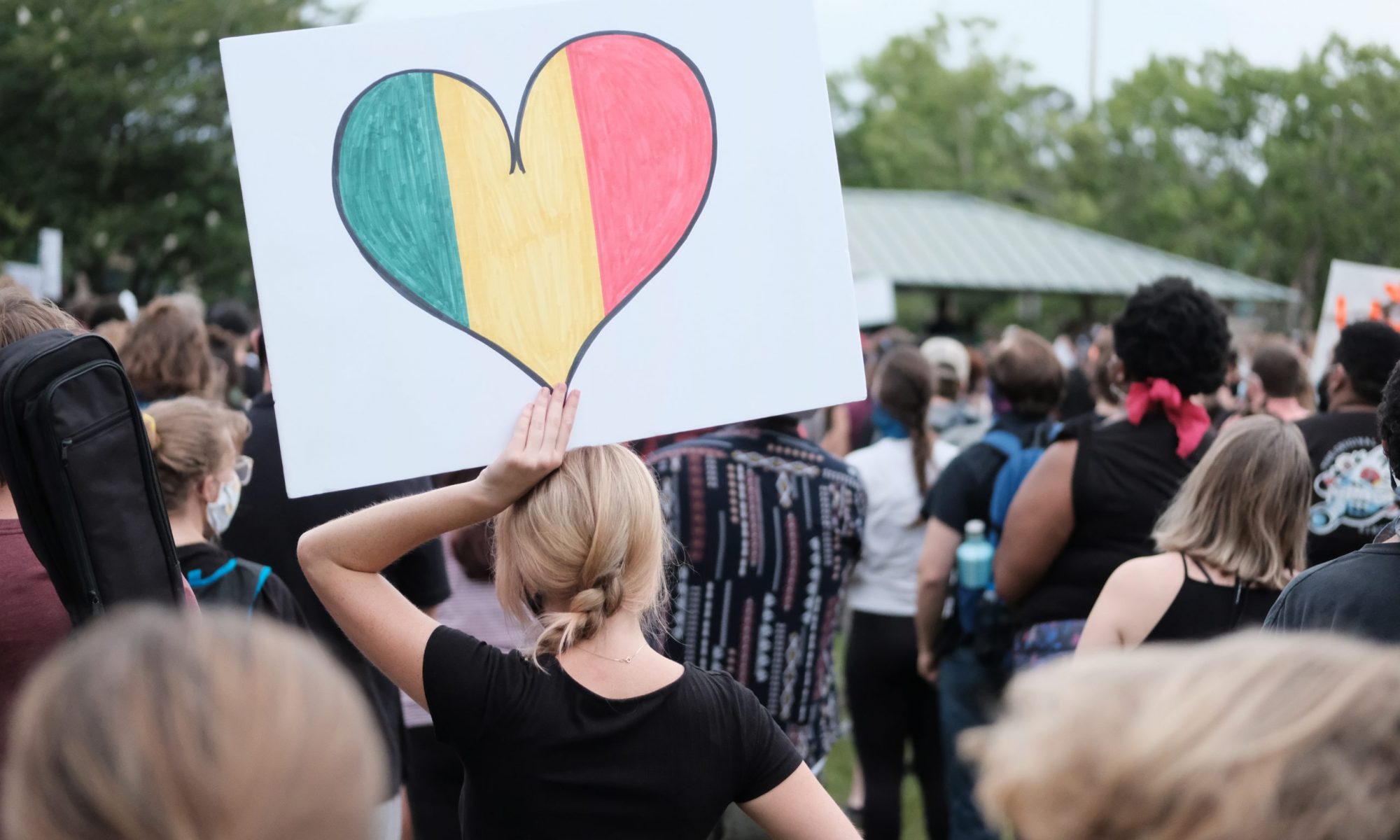
Thousands of our neighbors and friends have been turning out daily to peacefully call for police accountability and racial justice after the killing of George Floyd. These have been the largest, most diverse civil rights marches in Jax history. In the most recent of the daily protests on June 6, over 8000 came out, with crowds stretching for over a mile in the streets surrounding the Duval County Courthouse.