My journey started when I was given an opportunity while I was still a teenager. I can remember the recruiter mentioning that they were doing me a favor but with no degree and a new baby on the way, I was excited to take the minimum wage job.
It changed my life.
For background, you should know that my mom was a teenager when she had me. That meant I grew up cohabitating with aunts from time to time, in houses where diversity wasn’t a concept, it was a lived experience. Money was tight, and interestingly, kids in tight-money households find each other across every line the rest of the world draws. I ended up amongst the diverse communities everywhere we went, because that’s where I belonged.
At that first job, somebody else saw something in me and gave me a shot most kids in my spot never get—the chance to lead a diversity effort at the corporate scale. The focus was on generational diversity, and as a young cis white male, leading that work cracked open every other dimension of diversity for me in a way that I hadn’t experienced, up close, with real impact on the line.
As I ventured into the new frontier of generational diversity, I learned quickly that it touches every other dimension. Everyone’s an age. Building generational awareness turned into conversations with every other community in my circle. After stepping away from the generational diversity work, I had the chance to serve in other groups too — AVAS, the Association of Voices from Asia South being another with its own imprinted experiences. Once again, I found myself amongst people whose lives looked nothing like mine on the surface. But I listened, I saw them, and I learned we weren’t so different.
I had the opportunity to engage with programs like Real Talk Real Change; partner with community groups like Big Brothers Big Sisters; and to listen to a thousand stories from people who were excited to share, and all had to do was show up.
At the same time, somebody gave me another shot: the chance to learn Six Sigma and Lean techniques – operational excellence at scale. Those two tracks, the diversity work and the operational discipline, became one skill set in my hands. The discipline taught me how to make a case to leadership while the diversity work taught me whose voice to champion. Put them together and you get the way I have done every important thing in my career since: Build solutions from what the people doing the actual work tell you. That listening turned into million-dollar solutions for big companies, and into a career for me.
Years later working at Aetna, I had the chance to found a multi-generational Employee Resource Group and to continue doing the work alongside leaders across every dimension of diversity at the company. I am still doing this work today. I am proud to serve as the current Community Outreach Lead for our company’s Black Employee Resource Group, invited to support in that role, again, by people who saw something in me.
When I close my eyes, I can see their faces: the ones who helped me get started; the ones who gave me the chance to be seen; the ones who got me into continuous improvement programs; the ones who shared experiences back then and are still sharing their experiences with me, today, like on our recent trip to Tallahassee. I am grateful for every one of them.
Speaking of that trip, while on the bus I had the opportunity to make a new friend who told me something I am still processing and that will certainly shape my thinking as I go forward.
This man spent a lifetime as a public school teacher before retiring into a professor role at our local nursing school. He talked about black centers of excellence that existed before integration. When integration came, it didn’t really integrate—it absorbed educators and their techniques. One faculty member, a couple of teachers, and even a janitor would go one way, along with a handful of high-performing students from different grades while another cohort of professionals and students were selected to go another. The concentrated Black excellence got broken into pieces and dispersed into majority-dominant educational models, where they became lost features inside somebody else’s system.
The things that made for excellence got diluted and over time, the system forgot what that excellence even looked like.
Integration meant absorption.
The same weakening tactic is being used again, right now. It’s called Gerrymandering.
Concentrations of minority political power are being fragmented and spread across majority-dominant districts, where it becomes a minority feature inside somebody else’s system. The people defending the moves use phrases like “it’s race neutral” and “color wasn’t a factor,” as if those phrases prove their good intentions. They don’t. They prove the absorption tactic has become better at hiding what it is, and emphasizes the need for cultural competency more than ever before.
It is exactly why DEI programs must exist. The thing critics call DEI—recognizing, preserving, and celebrating the excellence that minority communities create—is the only thing pushing back on a system that has been quietly bleaching our vibrancy for generations. The thing the critics call neutrality is the absorption itself and it is unAmerican by its very nature.
I am a DEI hire because the poor, uneducated white kid that was given a shot 20+ years ago is no different than his minority neighbor.
The shot that started my life came from somebody who chose to see me. The next person is waiting to be seen. That is what DEI is really about, and that is what we must defend.
_________
Mike Sell describes himself as a father, husband, and professional problem solver who looks at ‘broken’ systems and asks who designed them this way and who for. He’s also an insightful writer and IJR member. You can check out Mike’s excellent Substack blog at this link.
EDITOR’S NOTE: This content is courtesy of our friends at United Nassau Florida. Aaron Bean is a sitting US Conggressman representing Florida District 4, which includes parts nof Nassau and Duval counties, inclduing the neighborhoods of Riverside, Avondale, and Murray Hill.
This video isn’t something we want to subject you to, but it’s eye-opening. Sometimes you have to hear it straight from the horse’s mouth for the impact to sink in. We apologize for the unpleasant content, but we believe it’s important.
Congressman Bean loves to talk about “protecting police dogs.” He praises his K-9 Protection Act as if it were the height of compassion, yet says nothing about the people brutalized by the same agencies those dogs serve. While ICE and Border Patrol have slammed unarmed civilians to the pavement and terrorized families, Bean’s outrage begins and ends with the animals.
We value every life, human and canine, but compassion that ignores human suffering isn’t compassion at all.
Behind that grin lies something darker a steady stream of lies, hypocrisy, and cruelty wrapped in charm.
The man who claims to “stand with working families” voted for a so-called “Clean Continuing Resolution”, a bill that would have allowed subsidies to expire for the Affordable Care Act (Obama Care) and block Medicaid extensions.
Had that bill passed in the Senate, Marketplace healthcare premiums would have skyrocketed, and health coverage would have been stripped from millions of Americans, leaving families across Florida facing impossible medical bills or no care at all.
He calls it “fiscal responsibility”
We call it what it is: an attack on the health and dignity of the people he’s sworn to represent.
When Bean talks about compassion, he means “damage control.”
He wrote letters asking utility companies to show “mercy” to federal workers, the same workers losing paychecks because he voted for a budget bill that slashed ACA subsidies, fueling the shutdown standoff in the Senate.
He calls it “compassion”
We call it what it is: Theater.
He grins beside dialysis patients and seniors in nursing homes while voting for the Republican “One Big Beautiful Bill Act”, legislation that threatens or eliminates the very programs those people rely on.
He calls it “fiscal discipline.”
We call it: Cruelty disguised as compassion.
Aaron Bean doesn’t stand with working families. He stands in front of them, for the photo op.
Bean is now proudly promoting his “LEO K-9 Protection Act,” calling police dogs “precious animals” who deserve “safe haven.”
But where is his compassion for people?
For the migrants and protesters slammed to the ground by ICE officers, for the people thrown into ravines and detention cages, for the workers who are unable to feed their families because of his votes.
He weeps for wounded dogs while ignoring human beings brutalized by the same agencies he glorifies.
Bean cries for K-9s while turning his head away from people
We call it: Selective empathy, the cruelty of moral convenience.
Now, he’s trying to sell the lie of a “Senate-led shutdown.”
Here’s the truth:
The shutdown began in the House, when MAGA Republicans refused to pass bipartisan funding that the Senate had already approved.
He claims Democrats “voted to keep the government closed.”
What he doesn’t say is that those bills were loaded with MAGA poison pills, deep cuts to healthcare, disaster relief, and environmental protections.
He created the crisis and now blames others for the pain.
It’s the oldest political trick in the book: “cause the fire, then pose with the hose.”
Bean’s job isn’t governing, it’s performing.
He loves ribbon cuttings and happy talk about “Florida sunshine.” Meanwhile, Florida families face rising prices, shrinking safety nets, and lost paychecks.
When the lights go off and the cameras turn away, his compassion disappears right along with them.
Aaron Bean doesn’t understand the No Kings movement because he doesn’t understand democracy.
He calls peaceful citizens “unruly.”
He praises power and mocks dissent.
And he serves a movement that would rather rule than represent.
I think it’s time we have a real, serious conversation about what happens after protesting–about what comes next. Too often, people say things like, “Oh, you’re just throwing a block party,” or “These protests don’t do anything.” But that misses the point entirely.
Protests do matter. They are a form of recruitment. They are how people first recognize that there’s a problem and realize they’re not alone. Mass demonstrations create safety in numbers, which helps those with anxiety or fear for their safety show up. Once they do, they meet organizations that share their values, and that’s how involvement begins. Coalitions form locally, statewide, regionally, and nationally among all kinds of groups, including veterans.
After Protesting: Building Power That Lasts
After protesting, the next steps are mass demonstrations, boycotts, and strikes. But here’s the thing: we can’t realistically boycott or strike unless we have a way to support people through it. We can’t call for economic disruption if we don’t have alternative material sources for the goods and services we are boycotting.
If we ever reach the point of a general strike, we will have to be self-sustaining, feeding ourselves, housing ourselves, and supporting one another. Every major movement throughout history that truly worked and sustained itself had one thing in common: a foundation of community defense and mutual support. That’s food for thought.
Learning from History
Every strong movement in history has had its dual sides, a Martin and a Malcolm. Anyone who ignores that isn’t recognizing history for what it really is. You need both. The larger movement depends on both nonviolence and defense. We don’t perpetrate violence; we defend against it.
Some people think community defense means violence or anarchy, but it’s not that at all. It’s about building resilience, taking care of one another, and being ready when systems fail. It’s going back to how early America once functioned, when people bartered, helped one another, and survived together.
What Community Defense Really Means
Community defense isn’t aggression; it’s preparation. It’s making sure your community can stand together when it matters most. It means that if your neighbor is taken, you know who to call. It means helping them get a lawyer, checking on the elderly down the road to make sure they have groceries and companionship. That’s community defense.
And here’s something that confuses me: we say “ACAB” all day, but we haven’t built viable alternatives for community safety. We call out the system’s failures, but we’re not prepared to take over those responsibilities ourselves. Radical mutual aid means that if the system fails, we can still feed, clothe, and protect our own.
Building Local Resilience
Take where I live, Florida. Disaster preparedness here isn’t great. If a massive hurricane hits and the federal government fails us, it’s on us to pick up the pieces, rebuild, and make sure no one is left hungry, cold, or without shelter. That’s community defense in action, creating local systems that can handle those crises at the neighborhood level and then scale outward.
You start small, your block, your area, your town. Like in Jacksonville: Mandarin, Riverside, the Beaches. Each of those communities connects to the next, and together they can respond to larger problems. If a hurricane hits, we figure out which side of town was hit hardest, and we move. We allocate resources and get people what they need. That’s organized community resilience.
Facing Reality
Too many people still believe the midterms or the next election will fix things. I wish that were true, but even if elections happen, and who says they will, they won’t change the trajectory we’re on. The Constitution promises elections, freedom of the press, accountability, yet the Department of Defense removed the entire press corps and prohibited military members from talking to Congress. That’s a violation of U.S. law.
So if you still think everything will go back to normal, I’m glad you have hope. But I’m preparing for the worst, and I hope my preparation turns out to be unnecessary. That’s not paranoia. That’s realism. It’s experience. It’s being a veteran and having been trained to survive.
Values and Call to Action
I was taught from a young age that we take care of our own. If you know me, you know that loyalty means a lot to me, not blind loyalty, but loyalty rooted in values. The Army values — loyalty, duty, respect, selfless service, honor, integrity, and personal courage — are how I try to live. I fall short, because I’m human, but I keep trying.
So no, I’m not an alarmist. I’m a realist. And even if we never need these systems, at least they’ll exist if we do. That’s the point.
Right now, we’re underprepared as veterans, as neighbors, and as communities. It’s time to organize, prepare, and move forward. It’s time to build the networks and systems that can protect and sustain us when the institutions we’ve relied on fail.
Because the truth is simple: no one is coming to save us. We keep us safe.
And One Last Thing
Given the new executive order about the “ideology of anti-fascism” and “American values,” I’m sure this post, and probably a few others, have put me on a watchlist. And that’s fine.
I’m not anti-American. I love this country. And that’s exactly why I’m getting prepared to rebuild it after it falls.
———-
Katie Chorbak is the President of 50501 Veterans, a Jacksonville native, Bishop Kenny graduate and a retired U.S. Army Staff Sergeant (74 D). A fifth-generation combat veteran, she now works in the construction industry, with projects including Ribault High School. For over a decade, she has led veteran advocacy efforts, helping drive a 2021 federal policy change protecting sexual assault survivors in the military. Katie has received multiple awards for her work, most proudly being named a Woman Veteran Trailblazer by the U.S. Department of Veterans Affairs.
“No one is free until we are all free.” A scene from the protest for social justice and police accountability at the Duval County Courthouse. Jacksonville, Florida, 6-6-2020.
Thousands of neighbors and friends filled the little neighborhood park in the San Marco area of Jax to demand systemic change and to call for justice for George Floyd and all victims of police violence. Jacksonville, Florida, 6-3-2020.
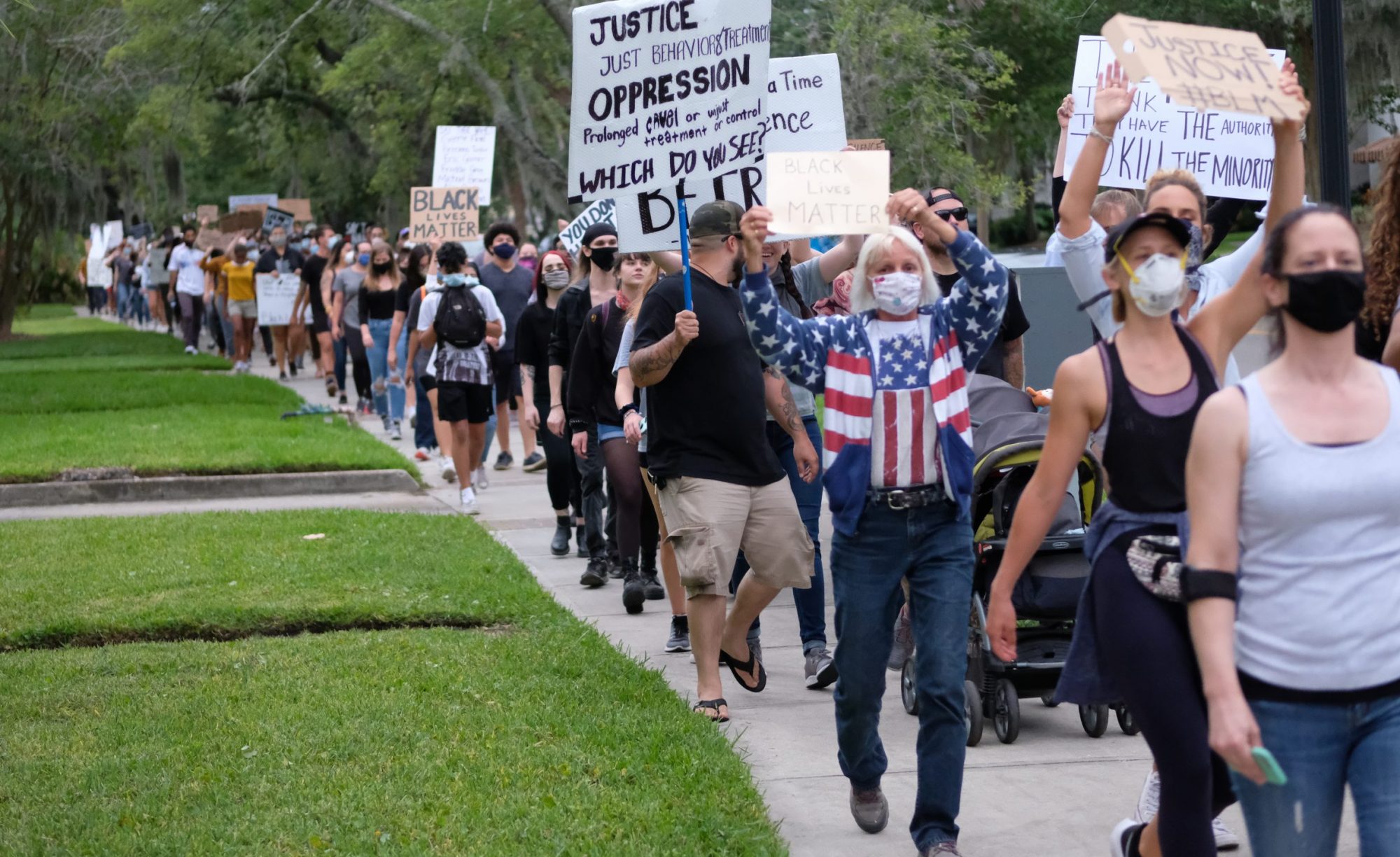
Thousands marched through the San Marco area just south of downtown to call for police accountability and racial justice. Jacksonville, Florida, 6-3-2020.
A scene from the protest for social justice and police accountability at the Duval County Courthouse. Jacksonville, Florida, 6-6-2020.
“Latinos for Black Lives.” A scene from the protest for social justice and police accountability at the Duval County Courthouse. Jacksonville, Florida, 6-6-2020.
“Silence is violence.” A scene from the protest for social justice and police accountability at the Duval County Courthouse. Jacksonville, Florida, 6-6-2020.
“Black lives matter.” A scene from the protest for social justice and police accountability at the Duval County Courthouse. Jacksonville, Florida, 6-6-2020.
March organizers were well prepared and were joined by a large team of peacekeepers, medics, and legal observers. A scene from the protest for social justice and police accountability at the Duval County Courthouse. Jacksonville, Florida, 6-6-2020.
“No justice, no peace.” A scene from the protest for social justice and police accountability at the Duval County Courthouse. Jacksonville, Florida, 6-6-2020.
A scene from the protest for social justice and police accountability at the Duval County Courthouse. Jacksonville, Florida, 6-6-2020.
”Release all JSO body cam footage.” Currently, footage is held by JSO for years before release. A scene from the protest for social justice and police accountability at the Duval County Courthouse. Jacksonville, Florida, 6-6-2020.
We have a lot of work to do in the months and years ahead. This will be one of the key actions that each of us can and must take. A scene from the protest for social justice and police accountability at the Duval County Courthouse. Jacksonville, Florida, 6-6-2020.
This is what democracy and diversity looks like. A scene from the protest for social justice and police accountability at the Duval County Courthouse. Jacksonville, Florida, 6-6-2020.
A scene from the protest for social justice and police accountability at the Duval County Courthouse. Jacksonville, Florida, 6-6-2020.
A scene from the protest for social justice and police accountability at the Duval County Jail. Jacksonville, Florida, 5-30-2020.
“Stop killing black people. Enough is enough.” A scene from the protest for social justice and police accountability at the Duval County Courthouse. Jacksonville, Florida, 6-6-2020.
“Stop killing us!” A scene from the protest for social justice and police accountability at the Duval County Jail. Jacksonville, Florida, 5-30-2020.
Thousands of our neighbors and friends have been turning out daily to peacefully call for police accountability and racial justice after the killing of George Floyd. These have been the largest, most diverse civil rights marches in Jax history. In the most recent of the daily protests on June 6, over 8000 came out, with crowds stretching for over a mile in the streets surrounding the Duval County Courthouse.
The Jax community turned out to fill the Avondale UMC at the Jax Lights for Liberty vigil, one of hundreds of events held around the US and the world. Over two hundred neighbors and friends joined in the call for justice and the closure of detention camps like the one in Homestead, Florida—this despite heavy rains in Jax and a resulting last-minute change in venue. Some speakers shared their experiences with asylum seekers hoping for fair and humane treatment, while others bore witness to the abuses taking place in the camps themselves.
This is a busy weekend of protest against Trump’s ongoing family separation and imprisonment policies with no less than four actions taking place. Despite last week’s Executive Order, kids are still separated, families who have not committed a crime are being imprisoned indefinitely, and parents are being a given a choice of being deported immediately (back to whatever dangerous situation they were fleeing) without a hearing on their asylum claims OR potentially losing their children forever.
Indivisible Jax Riverside, Women’s March Jax and a diverse coalition of many other community groups and individuals are joining nationwide protests to demand change. Come out if you can to add your voice against these cruel and illegal actions being done in our name.
March for the Children — Friday, June 29 at 3:30pm – Outside of the ICE Office located at 13077 Veveras Dr, Jacksonville, FL 32258. Follow the link for important details on parking and protest guidelines. www.facebook.com/events/223071225156476
Families Belong Together Protest at ICE Detention — June 30, 10am-12am at the Baker County Detention Center in MacClenny. This event will be attended by Central Florida and Jacksonville Women’s March, as well as other organizations. We are attempting to gather a large crowd to keep the heat turned up on I.C.E. until more is done to reunify children and families. Check out this link for details. www.facebook.com/events/495170534234407/?ti=cl
Families Belong Together Protest — June 30, 3pm-5pm in front of Jacksonville City Hall. Join this protest to bring more awareness locally. Check out this link for details. act.moveon.org/event/families-belong-together/20212
Vigilia por las Familias Unidas (Vigil for United Families) — Saturday, June 30 at 7pm at Drew Park. This vigil is being led by members of the Hispanic community. www.facebook.com/events/1950401148337247/
A day after neo-Nazis and white supremacists marched violently on an American city, people in Jax of all colors, faiths, genders and backgrounds stood together with the people of Charlottesville against the hate. Candles were lit and a moment of silence was observed in remembrance of those who were killed or injured while defending love and equality.